
สวัสดีค่ะ from Thailand! My name is Emma. I am a sophomore majoring in Neuroscience on the pre-med track, and this semester, I have been studying in Salaya, a small town outside of Bangkok. This past weekend, I had the opportunity to participate in service-learning activities in Krabi, and I wanted to share my reflections.
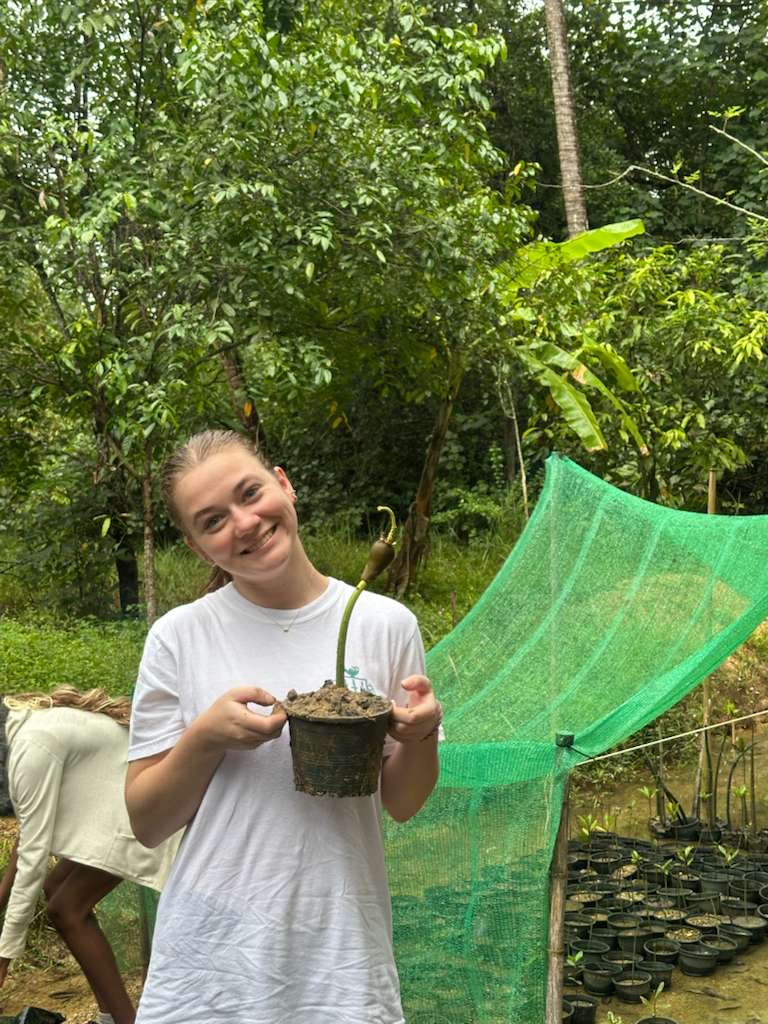
On Friday morning, we woke up early to head to Spirit Mountain to begin our wellness retreat. We met the amazing staff of Nature Mind-ED, who guided us through our weekend and then drove us to our first activity: a 7-kilometer (almost 4.5 miles!) kayak expedition through a mangrove forest. While kayaking, we made a few stops to meditate, learn about the mangroves and conservation efforts, swim around, and simply enjoy the beautiful surroundings. Kayaking was an especially impactful activity. It gave me opportunities to bond with my kayaking partner and other students in the WorldStrides program, to learn about the importance of mangroves in the ecosystem, and to learn how we can focus more on sustainability and conservation. As we paddled around, we were instructed to pick up any mangrove seeds we found. After kayaking, we brought the seeds to Na Sook, a mangrove nursery, where I then had the opportunity to plant multiple mangroves. It was such an amazing experience to learn and give back to the environment with my friends!
On Saturday morning, we returned to Spirit Mountain for another day of service learning. We began our morning with meditation and breath work, really focusing on calming ourselves and being in the moment. We then had the opportunity to learn about Spirit Mountain’s coral research. I enjoyed learning about causes of coral bleaching – it provided lots of insight into how we can protect reefs, which are home to many ocean organisms! Spirit Mountain’s research team has 3 main methods of rehoming coral that we got to experiment with – a twine method, a superglue method, and a zip tie method. The twine method involves tying twine around metal poles, untwisting the twine, and sticking coral in between the unraveled twine. This method was hard, especially since the twine had been wrapped around the metal so tightly. The superglue method is exactly what it sounds like – supergluing coral to a rock, then using a catalyst to speed up the reaction. This was definitely the easiest and most interesting of the three methods. Finally, the zip tie method involves either plastic or metal zip ties being used to attach coral to a metal dome. We were informed that the metal zip ties are not very cost-effective and that the plastic zip ties are not very eco-friendly, so while this method was also relatively easy, it is not the best. As simple as these activities were, they helped me realize that even our small efforts can create a large impact.
This weekend has taught me to be more present, to slow down, and to think about the consequences my actions have, especially in terms of the environment. It has inspired me to spend more time meditating and to reduce my consumption of single-use plastics. I am incredibly grateful to WorldStrides for planning such an amazing trip and to Spirit Mountain and Nature Mind-ED for a truly impactful weekend of service-learning. I am so lucky to be living and learning in such a beautiful place with amazing people!